2,4,6-Trichlorobenzoyl chloride
CAS4136-95-2
2,4,6-Trichlorobenzoyl chloride (CAS 4136-95-2), known as the Yamaguchi reagent, is an aromatic acyl chloride used to activate carboxylic acids as mixed anhydrides. Together with triethylamine and DMAP it enables esterification and macrolactonization of hindered or sensitive substrates under mild conditions. King-Pharm supplies 2,4,6-trichlorobenzoyl chloride for research and production with a batch-specific certificate of analysis.
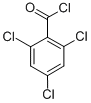
- CAS No.
- 4136-95-2
- Formula
- C7H2Cl4O
- Mol. weight
- 243.9 g/mol
- Appearance
- Colorless to Yellow-green Liquid
Product Description
2,4,6-Trichlorobenzoyl chloride is an aromatic acyl chloride bearing three chlorine atoms at the 2-, 4- and 6-positions of the benzene ring. It is the activating reagent of the Yamaguchi esterification and is widely used in total synthesis of natural products.
In the presence of a tertiary amine such as triethylamine, the carboxylate of the substrate acid attacks the reagent to form a mixed anhydride. DMAP then attacks the less hindered aliphatic carbonyl regioselectively, giving an acylpyridinium intermediate that reacts quickly with the alcohol to form the ester or, intramolecularly, the lactone.
Because the two ortho chlorine atoms shield the aromatic carbonyl, acyl transfer is directed to the substrate acid rather than to the trichlorobenzoyl group. This makes the method suitable for medium and large ring lactones run under high dilution, and for couplings where carbodiimide reagents give poor yields or difficult by-products.
The compound is a moisture-sensitive liquid; supplier data list a boiling point of 107–108 °C at 6 mmHg and a density of about 1.561 g/mL at 25 °C. When evaluating it, buyers usually check the assay, the content of free 2,4,6-trichlorobenzoic acid, the colour, and packaging that keeps out moisture.
Chemical Specifications
Identifiers
| CAS number | 4136-95-2 |
|---|---|
| Product name | 2,4,6-Trichlorobenzoyl chloride |
| IUPAC name | 2,4,6-trichlorobenzoyl chloride |
| Synonyms | 2,4,6-TRICHLOROBENZOYL CHLORIDE |
| Molecular formula | C7H2Cl4O |
| Molecular weight | 243.9 g/mol |
| MDL number | MFCD00075323 |
| PubChem CID | 2733703 |
| InChIKey | OZGSEIVTQLXWRO-UHFFFAOYSA-N |
| SMILES | C1=C(C=C(C(=C1Cl)C(=O)Cl)Cl)Cl |
Physical and chemical properties
| Appearance | Colorless to Yellow-green Liquid |
|---|
Applications
2,4,6-Trichlorobenzoyl chloride is used with triethylamine and DMAP to form esters and lactones from carboxylic acids under mild conditions.
Yamaguchi esterification
Activates carboxylic acids as mixed anhydrides for DMAP-promoted coupling with alcohols, including hindered substrates.
Macrolactonization
Closes medium and large ring lactones from hydroxy acids under high-dilution conditions.
Natural product synthesis
Serves as a key coupling reagent in total synthesis of macrolides and other complex natural products.
Acyl chloride intermediate
Introduces the 2,4,6-trichlorobenzoyl group into amides, esters and other derivatives in organic synthesis.
Quality Documentation
The following documents can be provided for 2,4,6-Trichlorobenzoyl chloride to support technical evaluation and purchasing. Documents are issued for the specific grade and batch supplied.
-
Certificate of Analysis (COA) Batch-specific test results against the specification.
-
Product specification The release specification with test items, limits and methods.
Packaging, Storage & Transport
Safety and transport
| Hazard Level | 第8类 腐蚀品 |
|---|
Packaging can be adapted to the order quantity and destination.
Frequently Asked Questions
How does the Yamaguchi method compare with carbodiimide (Steglich) esterification?
The Yamaguchi method avoids urea by-products such as dicyclohexylurea and is often preferred for macrolactonization and hindered acids, while carbodiimide coupling needs fewer steps for simple esters.
What are the key points when using 2,4,6-trichlorobenzoyl chloride?
Use anhydrous solvents and dry glassware, form the mixed anhydride with triethylamine first, then add DMAP; for lactonization, add the anhydride slowly to keep the substrate at high dilution.
How should 2,4,6-trichlorobenzoyl chloride be stored?
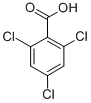
It is moisture sensitive and hydrolyses to 2,4,6-trichlorobenzoic acid and hydrogen chloride; keep it tightly closed under dry inert gas in a cool, dry place.
What is the CAS number of 2,4,6-Trichlorobenzoyl chloride?
The CAS Registry Number of 2,4,6-Trichlorobenzoyl chloride is 4136-95-2. 2,4,6-Trichlorobenzoyl chloride is also known as 2,4,6-TRICHLOROBENZOYL CHLORIDE.
What is the molecular formula and molecular weight of 2,4,6-Trichlorobenzoyl chloride?
The molecular formula of 2,4,6-Trichlorobenzoyl chloride is C7H2Cl4O, and its molecular weight is 243.9 g/mol.
What is 2,4,6-Trichlorobenzoyl chloride used for?
2,4,6-Trichlorobenzoyl chloride is used with triethylamine and DMAP to form esters and lactones from carboxylic acids under mild conditions.
Which quality documents are available for 2,4,6-Trichlorobenzoyl chloride?
The following documents are available for 2,4,6-Trichlorobenzoyl chloride: Certificate of Analysis (COA); Product specification. Contact King-Pharm to request the documents for a specific batch.
How can I request a quotation for 2,4,6-Trichlorobenzoyl chloride?
Send an inquiry for 2,4,6-Trichlorobenzoyl chloride (CAS 4136-95-2) with the required quantity, target specification, destination country and any documentation requirements. King-Pharm will confirm availability, packaging, lead time and price.
Related Products
Request a Quote for 2,4,6-Trichlorobenzoyl chloride
Tell us the required quantity, target specification, destination country and any documentation requirements. We will confirm availability, packaging, lead time and price.
Need custom synthesis or scale-up? Our group company CKS Technology offers custom synthesis, process development and scale-up.Page last reviewed on by Leo Xiao.