Oxobutanedioic acid (OAA)
CAS328-42-7
Oxaloacetic acid (OAA, oxobutanedioic acid, CAS 328-42-7) is a four-carbon keto dicarboxylic acid and a central intermediate of the tricarboxylic acid (TCA) cycle and gluconeogenesis. It is widely used as a substrate in citrate synthase, malate dehydrogenase and aminotransferase assays. Because it decarboxylates readily in solution, it is usually stored cold and dry. King-Pharm supplies oxaloacetic acid for research and production use with a batch-specific certificate of analysis.
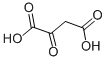
- CAS No.
- 328-42-7
- Formula
- C4H4O5
- Mol. weight
- 132.07 g/mol
- Appearance
- off-white crystals
Product Description
Oxaloacetic acid (2-oxobutanedioic acid, C4H4O5, MW 132.07) is a white crystalline solid bearing two carboxyl groups and an alpha-keto group. It is the conjugate acid of oxaloacetate, the anion that participates in central carbon metabolism. A melting point of about 161 °C with decomposition is reported in the literature, and water solubility of about 100 mg/mL is listed in supplier data.
In the TCA cycle, oxaloacetate condenses with acetyl-CoA to form citrate and is regenerated from malate by malate dehydrogenase. It is also the product of pyruvate carboxylase, the substrate of PEP carboxykinase in gluconeogenesis, and the keto partner of aspartate in transamination. In aqueous solution it exists in keto and enol forms and gradually decarboxylates to pyruvate.
Compared with generating oxaloacetate in situ from aspartate or malate, the free acid allows direct, defined dosing of the substrate in enzyme kinetics and coupled assays. Compared with salt forms, the free acid introduces no extra counter-ion into buffer systems, which simplifies pH and ionic-strength control.
Key purchasing points are assay, pyruvate content (the main degradation product), water content and appearance. Because the compound is sensitive to heat and moisture, buyers should confirm the storage temperature recommended on the label and prepare solutions fresh before use. King-Pharm provides a COA and specification with each batch.
Chemical Specifications
Identifiers
| CAS number | 328-42-7 |
|---|---|
| Product name | Oxobutanedioic acid |
| IUPAC name | 2-oxobutanedioic acid |
| Synonyms | OXOBUTANEDIOIC ACID |
| Molecular formula | C4H4O5 |
| Molecular weight | 132.07 g/mol |
| EC number | 206-329-8 |
| MDL number | MFCD00002592 |
| PubChem CID | 970 |
| InChIKey | KHPXUQMNIQBQEV-UHFFFAOYSA-N |
| SMILES | C(C(=O)C(=O)O)C(=O)O |
Physical and chemical properties
| Appearance | off-white crystals |
|---|---|
| Boiling Point | 174.794 ( ℃ ) |
Applications
Oxaloacetic acid is mainly used as an enzyme substrate and metabolic reference compound in life-science research.
Citrate synthase assays
Serves as the co-substrate with acetyl-CoA in citrate synthase activity assays, often used as a mitochondrial content marker.
Malate dehydrogenase assays
Used as the substrate for malate dehydrogenase, with activity followed by NADH oxidation at 340 nm.
Aminotransferase studies
Acts as the keto acid partner of aspartate in aspartate aminotransferase (AST) reactions and coupled assays.
Metabolism research
Used as a reference compound and supplement in studies of the TCA cycle, gluconeogenesis and cellular energy metabolism.
Quality Documentation
The following documents can be provided for Oxobutanedioic acid (OAA) to support technical evaluation and purchasing. Documents are issued for the specific grade and batch supplied.
-
Certificate of Analysis (COA) Batch-specific test results against the specification.
-
Product specification The release specification with test items, limits and methods.
Packaging, Storage & Transport
| Storage Temp | Store refrigerated (2–8 °C). Keep container tightly closed. ( ℃ ) |
|---|
Packaging can be adapted to the order quantity and destination.
Frequently Asked Questions
How should oxaloacetic acid be stored?
Keep it tightly closed, dry and cold; supplier recommendations range from 2-8 °C to -20 °C for long-term storage. Prepare aqueous solutions fresh, because oxaloacetate decarboxylates to pyruvate in solution.
Should I use the free acid or a salt form?
The free acid adds no counter-ion and suits assays where buffer composition must be controlled; it is acidic, so adjust the pH after dissolution. Salt forms dissolve to a near-neutral solution but bring in sodium or other cations.
Why does my oxaloacetate assay signal drift?
Spontaneous decarboxylation to pyruvate lowers the effective substrate concentration over time; keep stock solutions on ice and use them within the same working session.
What is the CAS number of Oxobutanedioic acid (OAA)?
The CAS Registry Number of Oxobutanedioic acid (OAA) is 328-42-7. Oxobutanedioic acid (OAA) is also known as OXOBUTANEDIOIC ACID.
What is the molecular formula and molecular weight of Oxobutanedioic acid (OAA)?
The molecular formula of Oxobutanedioic acid (OAA) is C4H4O5, and its molecular weight is 132.07 g/mol.
What is Oxobutanedioic acid (OAA) used for?
Oxaloacetic acid is mainly used as an enzyme substrate and metabolic reference compound in life-science research.
Which quality documents are available for Oxobutanedioic acid (OAA)?
The following documents are available for Oxobutanedioic acid (OAA): Certificate of Analysis (COA); Product specification. Contact King-Pharm to request the documents for a specific batch.
How can I request a quotation for Oxobutanedioic acid (OAA)?
Send an inquiry for Oxobutanedioic acid (OAA) (CAS 328-42-7) with the required quantity, target specification, destination country and any documentation requirements. King-Pharm will confirm availability, packaging, lead time and price.
Request a Quote for Oxobutanedioic acid (OAA)
Tell us the required quantity, target specification, destination country and any documentation requirements. We will confirm availability, packaging, lead time and price.
Need custom synthesis or scale-up? Our group company CKS Technology offers custom synthesis, process development and scale-up.Page last reviewed on by Leo Xiao.