1,1,3,3-Tetraethoxypropane (TEP)
CAS122-31-6
1,1,3,3-Tetraethoxypropane (TEP, CAS 122-31-6), also known as malonaldehyde bis(diethyl acetal), is a stable protected form of malondialdehyde (MDA). Under acidic conditions it hydrolyzes to release MDA, which makes it a common source of MDA standards for TBARS lipid peroxidation assays and a C3 dialdehyde equivalent in heterocycle synthesis. King-Pharm supplies 1,1,3,3-tetraethoxypropane for research and production use with a batch-specific certificate of analysis.
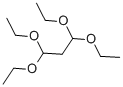
- CAS No.
- 122-31-6
- Formula
- C11H24O4
- Mol. weight
- 220.31 g/mol
- Appearance
- Colorless to Light-yellow liquid
Product Description
1,1,3,3-Tetraethoxypropane (C11H24O4, MW 220.31) is the tetraethyl acetal of malondialdehyde. It is a liquid at room temperature; supplier data report a boiling point of about 220 °C at 1013 hPa.
Free malondialdehyde is reactive and unstable on storage, so it is usually handled as an acetal. TEP is stable under neutral and basic conditions; on acid hydrolysis both acetal groups are cleaved and MDA is released in situ, ready to react with thiobarbituric acid or with dinucleophiles such as amidines, ureas and hydrazines.
Compared with isolated MDA salts, TEP is easier to store and dose by weight or volume, and the MDA concentration of a standard can be calculated from the amount of acetal hydrolyzed. Its methyl analogue, 1,1,3,3-tetramethoxypropane, serves the same purpose; the choice between them usually follows the published method being reproduced.
For purchasing, check assay (GC), water content and appearance on the COA. Because hydrolysis releases MDA, the material should be kept away from acids and moisture, and analytical users should confirm that the grade matches the requirements of their TBARS or HPLC method.
Chemical Specifications
Identifiers
| CAS number | 122-31-6 |
|---|---|
| Product name | 1,1,3,3-Tetraethoxypropane |
| IUPAC name | 1,1,3,3-tetraethoxypropane |
| Synonyms | 1,1,3,3-tetraethoxy-propan; Malonaldehyde diethyl acetal; Tetraethyl malondialdehyde acetal |
| Molecular formula | C11H24O4 |
| Molecular weight | 220.31 g/mol |
| EC number | 204-533-1 |
| MDL number | MFCD00009240 |
| PubChem CID | 67147 |
| InChIKey | KVJHGPAAOUGYJX-UHFFFAOYSA-N |
| SMILES | CCOC(CC(OCC)OCC)OCC |
Physical and chemical properties
| Appearance | Colorless to Light-yellow liquid |
|---|
Applications
1,1,3,3-Tetraethoxypropane is used mainly as a masked source of malondialdehyde:
MDA standard for TBARS assays
Acid hydrolysis of TEP generates malondialdehyde for calibration curves in thiobarbituric acid reactive substances (TBARS) lipid peroxidation assays.
Oxidative stress research
Used to prepare MDA reference solutions when quantifying lipid peroxidation markers in biological and food samples.
Heterocycle synthesis
Serves as a malondialdehyde equivalent that condenses with amidines, ureas or hydrazines to build pyrimidine and pyrazole rings.
Organic synthesis intermediate
Provides a protected C3 dialdehyde unit that can be unmasked under acidic conditions at the desired step.
Quality Documentation
The following documents can be provided for 1,1,3,3-Tetraethoxypropane (TEP) to support technical evaluation and purchasing. Documents are issued for the specific grade and batch supplied.
-
Certificate of Analysis (COA) Batch-specific test results against the specification.
-
Product specification The release specification with test items, limits and methods.
Frequently Asked Questions
Should I use tetraethoxypropane or tetramethoxypropane as the MDA standard?
Both release malondialdehyde on acid hydrolysis and are used in TBARS methods. Follow the acetal specified in the method you are validating, and calculate MDA concentration from the molar amount of acetal hydrolyzed.
How is the MDA standard solution prepared from TEP?
TEP is hydrolyzed in dilute acid to release MDA, and the hydrolysate is then diluted to the working range. Hydrolysis conditions and dilution steps should follow the specific assay protocol; prepare working standards fresh.
How should 1,1,3,3-tetraethoxypropane be stored?
Keep the container tightly closed in a cool, dry, well-ventilated place away from heat, ignition sources, acids and moisture, as acid contact triggers hydrolysis to malondialdehyde.
What is the CAS number of 1,1,3,3-Tetraethoxypropane (TEP)?
The CAS Registry Number of 1,1,3,3-Tetraethoxypropane (TEP) is 122-31-6. 1,1,3,3-Tetraethoxypropane (TEP) is also known as 1,1,3,3-tetraethoxy-propan; Malonaldehyde diethyl acetal; Tetraethyl malondialdehyde acetal.
What is the molecular formula and molecular weight of 1,1,3,3-Tetraethoxypropane (TEP)?
The molecular formula of 1,1,3,3-Tetraethoxypropane (TEP) is C11H24O4, and its molecular weight is 220.31 g/mol.
What is 1,1,3,3-Tetraethoxypropane (TEP) used for?
1,1,3,3-Tetraethoxypropane is used mainly as a masked source of malondialdehyde:
Which quality documents are available for 1,1,3,3-Tetraethoxypropane (TEP)?
The following documents are available for 1,1,3,3-Tetraethoxypropane (TEP): Certificate of Analysis (COA); Product specification. Contact King-Pharm to request the documents for a specific batch.
How can I request a quotation for 1,1,3,3-Tetraethoxypropane (TEP)?
Send an inquiry for 1,1,3,3-Tetraethoxypropane (TEP) (CAS 122-31-6) with the required quantity, target specification, destination country and any documentation requirements. King-Pharm will confirm availability, packaging, lead time and price.
Request a Quote for 1,1,3,3-Tetraethoxypropane (TEP)
Tell us the required quantity, target specification, destination country and any documentation requirements. We will confirm availability, packaging, lead time and price.
Need custom synthesis or scale-up? Our group company CKS Technology offers custom synthesis, process development and scale-up.Page last reviewed on by Leo Xiao.